About Sodium Lignosulphonate
Sodium lignosulphonate is a naturally occurring anionic surfactant and polymer. It has a brown powder or liquid appearance, no distinctive smell, is non-toxic, readily dissolves in lye and water, is precipitated by acid, and has a potent dispersing capacity. In order to create different products, sodium lignosulphonate can be processed, compounded, and changed as a surfactant. This means that it may be used primarily in the production of cement, resin, pesticides, asphalt, feed, water treatment, refractory material, oil field drilling, smelting, casting, and glue, among other things.
Technical specification
| PROPERTIES | SPECIFICATION | VALUE |
| Apperence | POWDER | POWDER |
| Color | LIGHT YELLOW | LIGHT YELLOW |
| Mass Fraction of Dry Substance, % Not Less | 96.40 | 96.40 |
| Active Substance, % Not More | 61.27 | 61.27 |
| Mass Fraction of Ash To dry substance, % Not More | 23.73 | 23.73 |
| PH Value | 5.25 | 5.25 |
| Limit of Durables of Dried up Samples by the Streching, Mpa Not Less | 0.71 | 0.71 |
| Packing Size : 20 KGS. |
Versatile Industrial ApplicationsSodium Lignosulphonate is widely recognized for its role in multiple industries. Its main uses include as an admixture in concrete for improved workability and as a dispersant for dyes and pigments. In agriculture, it's added to animal feed for enhanced nutrient absorption, while its dust suppressant properties make it valuable for environmental management.
Key Physical and Chemical PropertiesCharacterized by a purity of 93%, Sodium Lignosulphonate appears as a light brown powder with a density of 0.5-0.6 g/cm3. It is completely soluble in water and exhibits a pH of 7-9 in a 10% solution. Other specifications, such as moisture content (7%), water insoluble matter (2.0%), and sulphate content (4%), ensure its suitability for demanding industrial use.
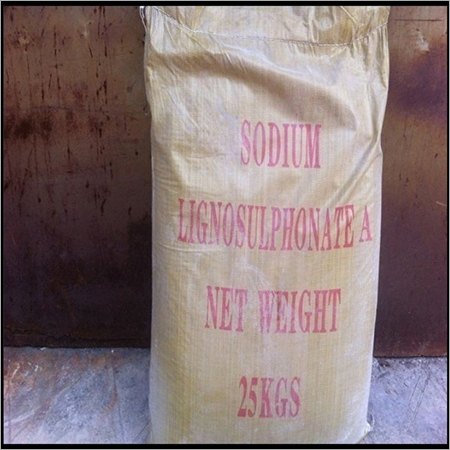
Safe Handling and Storage GuidelinesTo maintain product integrity, Sodium Lignosulphonate should be stored in cool, dry, and well-ventilated environments. With non-toxic properties and a shelf life of up to two years, it is safely managed in standard industrial settings. Suitable packaging formats include 25 kg bags or customized options to meet distributor and supplier needs in India.
FAQ's of Sodium Lignosulphonate:
Q: How should Sodium Lignosulphonate be stored to preserve its quality?
A: Sodium Lignosulphonate should be kept in a cool, dry, and ventilated area, sealed in appropriate packaging such as 25 kg bags. This helps maintain its purity, solubility, and physical properties throughout the two-year shelf life.
Q: What are the main industrial applications of Sodium Lignosulphonate?
A: Sodium Lignosulphonate is used as a concrete admixture to improve workability, an additive in animal feed, a dust suppressant for environmental control, and a dispersant for dyes. Its versatility makes it suitable for construction, agriculture, and chemical industries.
Q: When is Sodium Lignosulphonate most beneficial in concrete admixture processes?
A: It is particularly effective when added during the mixing stage to enhance plasticity, reduce water consumption, and improve the overall strength and workability of concrete.
Q: Where is Sodium Lignosulphonate commonly distributed and supplied?
A: The product is widely distributed and supplied in India, with availability tailored to meet industrial requirements in various sectors including construction and agriculture.
Q: What benefits does Sodium Lignosulphonate offer in animal feed?
A: As an animal feed additive, Sodium Lignosulphonate improves nutrient uptake and binding properties, leading to better feed efficiency and animal growth.
Q: How does the non-toxic nature and purity level of Sodium Lignosulphonate impact its industrial use?
A: Its non-toxic profile and high purity (93%) make it safe and reliable for use in sensitive applications like animal feed and as admixtures in concrete, ensuring consistent and effective results without health risks.
Q: What is the process for using Sodium Lignosulphonate as a dye dispersant?
A: Sodium Lignosulphonate is dissolved completely in water and incorporated into dye formulations, facilitating even dispersion of pigments and improving the stability and intensity of colors in textile and paper industries.








 Send Inquiry


 Send Inquiry