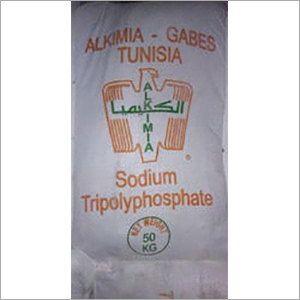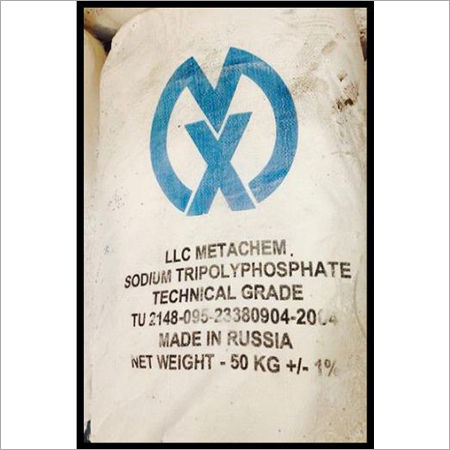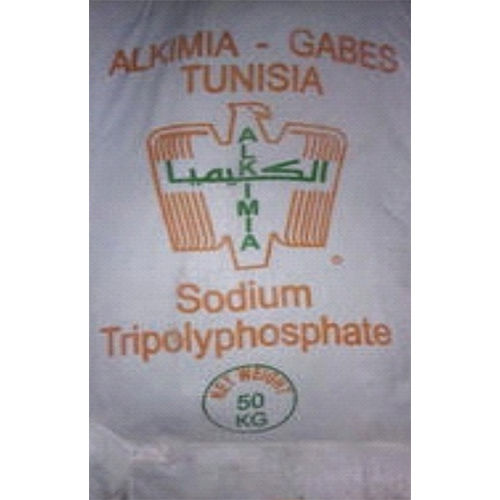


About STPP Tunisia
Technical specification
| PARAMETERS | UNITS | ANALYSIS | SP-0308-D REV 1 | NORMS |
| Appearance | / | OK
| Free flowing white powder Free | / |
| | | | from visible contaminants | |
| Odour | / | OK | The material should have no | / |
| | | | noticeable malodour | |
| P2O5 - Content as is | % | 56.16 | 56.00 Mini | ISO-3357/NFT-20486 |
| STPP- content as is | % | 94.78 | 94.00 Mini | ISO-3000/NFT-20492 |
| Other phosphates | % | 3.0 | 6.0 Maxi | ISO-3358/NFT-20488 |
| Temperature Rise Test (TRT) | oC | 11.6 | 10.0-14.0 | NFT 20496 |
| Phase I content | % | 22.4 | 16.0-32.0 | NFG 20496 |
| Volatile Matter (loss at 135 C - 4th) | % | 0.54 | 0.50-1.00 | ISO-2483/NFT-20401 |
| Insoluble matter in water | % | 0.036 | 0.100 Maxi | ISO-R850/NFT-20493 |
| Sodium sulphate content | % | 1.347 | 1.500 Maxi | Plasma Emission |
| Sodium chloride content | % | 0.3800 | 0.5000 Maxi | NFT-20495 |
| Fluoride content | % | 0.003 | 0.300 Maxi | / |
| Colour Value L a b | / | 96.48 | 95.00 Mini | Hunter L.a.b. |
| / | -0.12 | -2.50-2.50 | Hunter L.a.b. |
| / | 0.74 | 0.00-5.00 | Hunter L.a.b. |
| Blck Density | g/l | 700 | 700-1000 | ISO-697/NFT-73405 |
| R.O.H. After 1 mn After 5 mn | OC | 82.7 | 81.0-88.0 | OLTEN-TEST |
| OC | 89.6 | 85.0-92.0 | OLTEN-TEST |
| Particle size > 1000 microns > 500 Microns > 150 microns > 60 micron | % | 0.00 | 0.20 Maxi | ISO 2996/NFT-20485 |
| % | 0.00 | 2.00 Maxi | ISO 2996/NFT-20485 |
| % | 1.46 | 15.00 Maxi | ISO 2996/NFT-20485 |
| % | 9.45 | 50.00 Maxi | ISO 2996/NFT-20485 |
| > 6pH (1% solution) | / | 9.59 | 9.40-10.20 | ISO 2996/NFT-20494 |
| Trace metals Cr Co Ni Cu Fe Ca + Mg | ppm | 1.0 | 5.00 Maxi | Plasma Emission |
| ppm | <0.1 | 5.00 Maxi | Plasma Emission |
| ppm | 0.8 | 5.00 Maxi | Plasma Emission |
| ppm | <0.2 | 5.00 Maxi | Plasma Emission |
| ppm | 34 | 100 Maxi | Plasma Emission |
| ppm | 138 | 150 Maxi | Plasma Emission |
| Packing Size : 50 KGS. |
Key Properties of STPP TunisiaSTPP Tunisia, appearing as a white powder, delivers exceptional results due to its high purity (98% min) and optimal chemical composition. With a P2O5 content of at least 51% and Na2O at a minimum of 38%, it ensures superior efficacy in its intended uses. The product remains stable with low moisture (0.5% max) and minimal insoluble matter (0.1% max), maintaining a pH between 9.2 and 10.0 for consistent application.
Versatile Industrial ApplicationsThis sodium tripolyphosphate is a preferred choice for diverse sectors. In detergents, it enhances cleaning power and prevents mineral deposit formation. For water treatment, it improves ion exchange and controls scale. The ceramics industry values its dispersing and binding qualities. Its consistent quality makes it suitable for demanding industrial processes, ensuring optimal performance and reliability.
Packaging, Handling, and StorageSTPP Tunisia is securely packaged in 25 kg bags, facilitating safe transportation and storage. To preserve product integrity, it should be kept in cool, dry, and well-ventilated conditions. Proper handling extends the shelf life up to two years, so users can plan their inventory and usage effectively while preventing quality degradation.
FAQs of STPP Tunisia:
Q: How should STPP Tunisia be stored to maintain its quality?
A: STPP Tunisia needs to be stored in a cool, dry, and well-ventilated area. This ensures its high purity and prevents caking or moisture absorption, preserving its quality for up to two years.
Q: What are the main industrial uses of STPP Tunisia?
A: STPP Tunisia is predominantly used in detergents to boost cleaning efficiency, in water treatment plants for scale control and ion exchange, and in ceramics production for its dispersing and binding properties.
Q: When is it ideal to use STPP Tunisia in a manufacturing process?
A: STPP Tunisia should be added during stages where chelation, dispersing, or water softening is required, such as the formulation phase in detergents or the slurry preparation step in ceramics manufacturing.
Q: Where is the product sourced and supplied from?
A: STPP Tunisia is distributed and supplied by a leading distributor in India, ensuring prompt delivery and consistent quality for customers across related industries.
Q: How does using STPP Tunisia benefit detergent formulations?
A: In detergents, STPP Tunisia acts as a water softener, enhancing detergent cleaning power, preventing the deposition of minerals on fabrics and surfaces, and thus improving overall wash effectiveness.
Q: What is the process for using STPP Tunisia in water treatment?
A: For water treatment, STPP Tunisia is typically dosed into water streams to prevent scale formation and facilitate the removal of heavy metal ions, supporting efficient and long-lasting water system operation.
Q: What is the recommended shelf life for STPP Tunisia, and how can users ensure it remains effective?
A: The recommended shelf life is two years when stored as advised. Keeping the bags sealed and away from humidity will help maintain its chemical stability and effectiveness throughout this period.